Ask ChatGPT to name the leading logistics companies in Jordan. Ask Perplexity which clinics in Beirut do a specific procedure. Ask Gemini about a mid-sized manufacturer in Casablanca. You will get an answer every time. It will sound authoritative. A meaningful share of the time it will be incomplete, out of date, or simply wrong.
This is the MENA coverage gap. It is not that AI engines dislike the region. It is that they were trained and grounded on a web where the region is thinly represented, and a model with thin evidence still produces a confident answer.
What is the MENA coverage gap?
The coverage gap is the distance between how much economic activity happens in a market and how much verifiable, machine-readable information exists about it online.
MENA spans more than twenty countries. Business information is heavily distributed across WhatsApp, Instagram, closed directories and offline relationships. Very little of that is indexable. The engines cannot cite what was never published.
Why this is worse than being invisible
An absent brand loses an opportunity. A misdescribed brand loses trust. Wrong pricing, a closed branch, a service you dropped years ago, all delivered to a buyer in a confident paragraph with no visible source.
Why do AI engines get regional brands wrong?
To fix the problem you need to understand the two different modes an engine uses to answer. They fail in different ways.
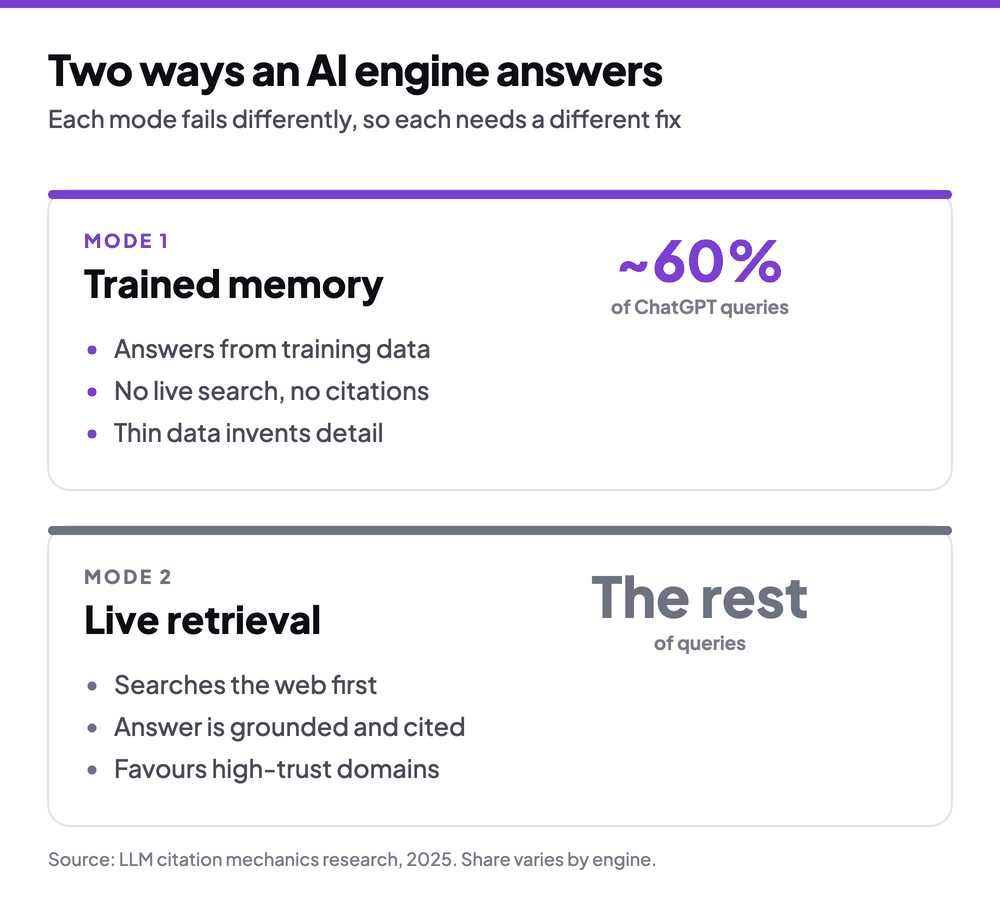
Mode one: trained memory
The model answers from what it absorbed during training. Roughly 60% of ChatGPT queries work this way. There are no citations because nothing was fetched.
For MENA brands this is the dangerous mode. If the training data held little about you, the model fills the shape of an answer with the most statistically plausible words. That is exactly how a hallucination is produced. It is not lying. It is completing a pattern.
Mode two: live retrieval
The engine searches, pulls sources, and writes an answer grounded in them. Here the question becomes which sources exist and whether they are about you.
The citation research shows engines lean heavily on a narrow set of high-trust domains. Reddit accounts for roughly 40% of LLM citations, Wikipedia around 26%, YouTube around 23%. In many MENA markets, local businesses have almost no footprint on any of those three.
How fragmentation multiplies the problem
A brand operating across the region is not solving one visibility problem. It is solving several at once, and they do not share a solution.
| Dimension | What varies across MENA | Effect on AI answers |
|---|---|---|
| Language | Modern Standard Arabic, Gulf, Levantine, Egyptian and Maghrebi dialects, plus English and French | The same question in two languages returns different brands |
| Query language | Arabic script, Latin transliteration, and code-switching in one sentence | Brand name variants fragment the entity |
| Source availability | Strong press in some markets, almost none in others | Retrieval quality swings by country |
| Directory coverage | Mature in the Gulf, patchy in North Africa and the Levant | Entity records are inconsistent or absent |
| Regulatory naming | Legal entity names differ from trading names | Models split one company into several |
Five fragmentation dimensions that make MENA visibility harder than a single-market problem.
How do you close the gap?
The fix is unglamorous and it works. You are building a verifiable public record that a machine can resolve to one entity.
1. Run a hallucination audit first
Before changing anything, document what the engines currently say. Ask the same twenty buying questions across ChatGPT, Google AI Overviews, Perplexity and Gemini, in both Arabic and English. Log every claim. Mark each as correct, outdated, missing or fabricated.
That log is your baseline. Without it you cannot prove anything improved.
2. Consolidate the entity
Pick one canonical name, one legal name, one address format, one description. Apply it everywhere. Add sameAs links in your Organization schema pointing at every profile you control. You are telling the machine these records are all one company.
3. Publish the facts the engines keep getting wrong
If a model says you operate in three cities and you operate in six, publish a clear locations page with structured data. Correct the record at the source rather than arguing with the output.
4. Build presence on the sources that actually get cited
A well-maintained Wikipedia entry where the notability criteria are genuinely met. Real participation in relevant communities. Video content, because video is cited far more than most teams expect. Regional press coverage with consistent naming.
5. Treat each market as its own surface
Because only about 11% of domains cited by ChatGPT also appear in Perplexity, and because source availability varies by country, a single regional programme will underperform. Prioritise the two or three markets that carry your revenue.
Where the leverage is
In thin-coverage markets you need far less content to become the best available source than you would in a saturated one. The gap that hurts you is the same gap that lets you win quickly.
Measuring it without guessing
Hallucinations do not announce themselves. They surface when a customer repeats something wrong back to your sales team, which is far too late.
Continuous monitoring is the only reliable approach. 99Visibility is purpose-built for this: it audits how AI platforms describe a brand across engines, detects hallucinations and coverage gaps, and prescribes the fix rather than handing you another chart. For the underlying theory, their guide to how AI decides citations is worth reading before you spend on tooling.
Frequently asked questions
Can we get AI engines to correct a wrong fact directly?
Not by request. You change what they draw on. Publish the correct information in structured form, get it reflected on third-party sources they trust, then re-audit. Correction follows evidence.
How often do the answers change?
Constantly. Answers vary with phrasing, session and model updates. That is why a single check is close to meaningless and a tracked series is not.
Is this a problem for large regional brands too?
Yes. Size does not guarantee a clean machine-readable record. Large groups often have worse entity consistency because they have more subsidiaries, trading names and legacy listings pulling in different directions.
Do we need Arabic content to fix this?
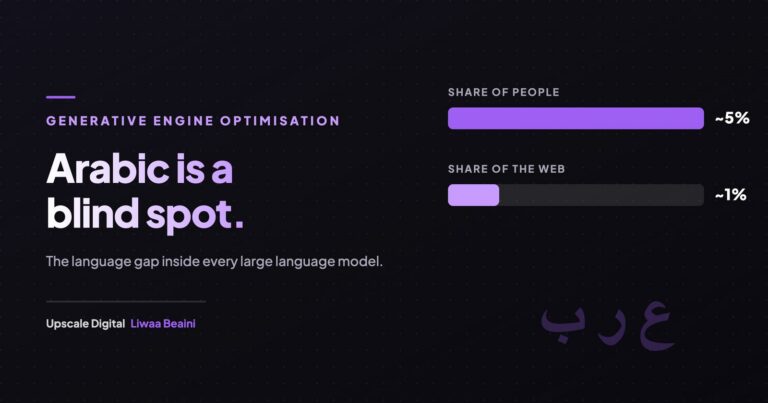
If your buyers ask in Arabic, yes. Arabic is heavily underrepresented on the web relative to the number of people who speak it, which directly limits what engines can retrieve for Arabic queries.
Where this leaves you
AI engines are describing MENA businesses today with incomplete evidence, and they will keep doing it. The record they draw on is the one thing you can change.
Start with the audit. Twenty questions, four engines, two languages, written down. You will know within an afternoon whether the engines are describing your business or inventing it.
Sources and further reading
- Ahrefs, analysis of 78.6M AI interactions across ChatGPT, Perplexity and Google AI Overviews, 2025.
- Goodie, cross-platform citation analysis, 5.7M citations, showing roughly 11% domain overlap between ChatGPT and Perplexity, 2025.
- Surfer SEO, AI Overviews study covering 36M overviews and 46M citations, 2025.
- Statista, most-cited domains in large language model responses, 2025.
- Digital Bloom, research on AI citation depth, including 82.5% of citations pointing to deep pages, 2025.
- W3Techs, usage statistics for content languages on the web.
- 99Visibility, how AI decides citations.
Want a free AI search audit for your brand?
We'll check your visibility across ChatGPT, Perplexity and Google AI Overviews for your top keywords — and show you exactly where to improve. 30 minutes, no obligation.
Book a Free Call