A buyer in Riyadh wants a marketing agency. Five years ago they opened Google and scanned ten blue links. Today a growing share of them open ChatGPT, or they stay on Google and read the AI Overview that sits above every result. Either way, one answer comes back. It names two or three companies. Everyone else is invisible.
That is the shift Generative Engine Optimisation exists to handle. In the GCC it matters more than most places, because the region combines very high AI adoption with very thin published data about local brands. The engines are confident. They are also frequently wrong.
What is Generative Engine Optimisation?
Generative Engine Optimisation (GEO) is the practice of shaping how AI systems describe and recommend your brand. It covers ChatGPT, Google AI Overviews, Perplexity, Claude, Gemini and the assistants built into browsers and phones.
Traditional SEO fights for a position in a list. GEO fights for a sentence inside an answer. Those are different games with different rules, and the rules are measurable.
The short definition
SEO earns you a ranking. GEO earns you a mention. If an AI engine answers a buying question without naming you, your ranking did not matter for that query.
Why is the Gulf different from other markets?
Three things stack up in the GCC that do not stack up elsewhere at the same time.
Adoption is near universal. Saudi Arabia and the UAE sit among the highest internet and smartphone penetration rates in the world, per DataReportal’s annual reporting. New interfaces get adopted quickly here. AI assistants are not a future behaviour in this market, they are a current one.
Deal sizes are large. A single mishandled recommendation in real estate, healthcare, professional services or B2B industrial supply can be worth six figures. The cost of being left out of an answer is not theoretical.
The published record is thin. This is the part most teams miss. Large language models learn from what is written down and indexed. Many strong Gulf companies have almost no independent, structured, machine-readable record of what they do. They have a website and social profiles, and that is close to it.
How do AI engines actually choose who to name?
This is where opinion should stop and data should start. Several large studies published through 2025 analysed how AI systems build answers. Their combined sample runs into the tens of millions of citations.
| Study | Sample | Coverage |
|---|---|---|
| Ahrefs | 78.6M AI interactions | ChatGPT, Perplexity, AI Overviews |
| Surfer SEO | 36M AI Overviews, 46M citations | Google AI Overviews |
| Goodie | 5.7M citations | Gemini, ChatGPT, Claude, Perplexity |
| SearchAtlas | 5.17M citations | OpenAI, Gemini, Perplexity |
The main public citation studies behind current GEO practice, 2025.
Four findings from that body of work change how you should plan.
1. A large share of answers never cites anything
Roughly 60% of ChatGPT queries are answered from the model’s own trained knowledge, with no live web retrieval at all. When that happens there is no link to win. The only thing that decides whether you appear is whether the model already learned your brand exists.
That reframes the work. Part of GEO is not about pages. It is about being written about in enough credible places that you become part of what the model knows.
2. When engines do retrieve, they favour a narrow set of sources
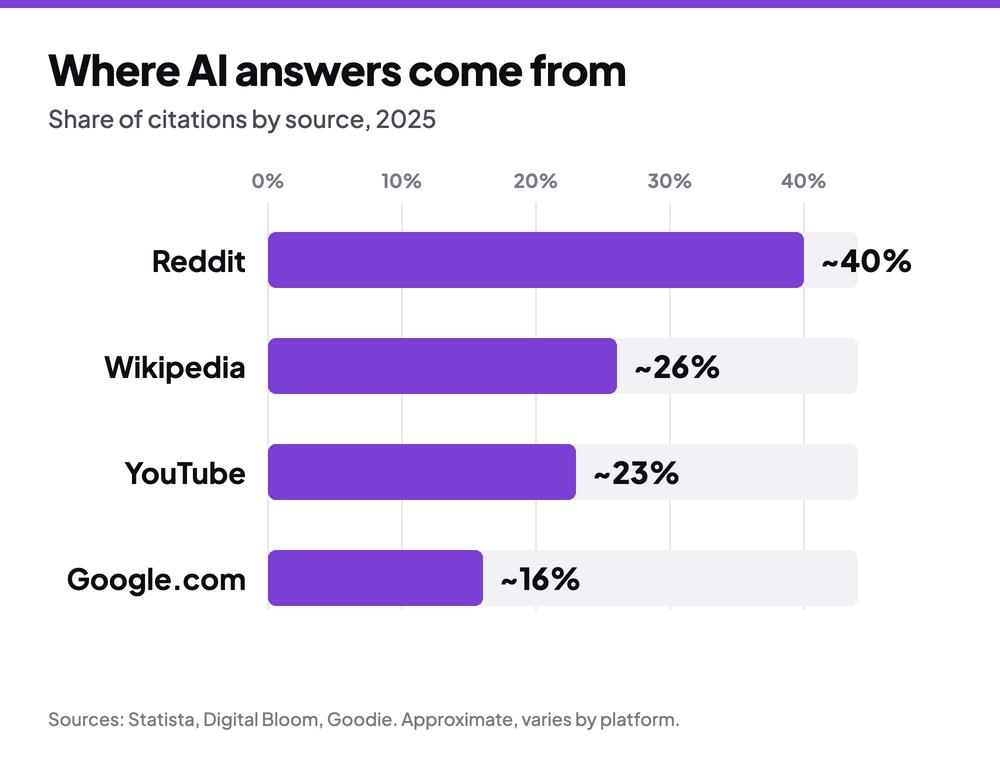
Citation analysis puts Reddit at roughly 40% of LLM citations, Wikipedia around 26%, and YouTube around 23%. Community discussion, encyclopedic reference and video carry disproportionate weight compared with brand-owned pages.
3. Deep pages beat homepages
Around 82.5% of AI citations point at deeply nested pages rather than homepages. A specific, thorough page answering one question outperforms a polished homepage that gestures at everything.
4. Platforms disagree with each other
Only about 11% of domains cited by ChatGPT are also cited by Perplexity. Winning on one engine tells you very little about the others. If you measure one platform, you are measuring roughly a tenth of the picture.
What actually moves AI visibility?
The same research isolates which signals correlate with getting cited. The honest summary is that classic SEO metrics matter less than most agencies will admit, and structure matters more.
| Signal | Measured effect | Priority |
|---|---|---|
| Brand mentions across the web | 0.334 correlation, the strongest single predictor | Critical |
| E-E-A-T signals | r=0.81 correlation with AI Overview presence | Critical |
| Original data tables | 4.1x more citations | High |
| Content freshness (under 30 days) | 3.2x more citations | High |
| Schema markup | 2.5x higher visibility | High |
| Clear H2/H3 and bullet structure | 40% more likely to be cited | High |
| Keyword density, content length | Minimal correlation | Low |
GEO ranking factors and their measured impact. Sources listed at the end of this article.
The one-line takeaway
Publish quotable, structured, well-sourced pages, and get mentioned by third parties that AI engines already trust. That combination does most of the work.
A GEO playbook for GCC businesses
Here is the sequence we run for clients across Saudi Arabia, the UAE and Lebanon.
Step 1: Audit what the engines already say about you
Ask each major engine the questions your buyers ask. “Best industrial supplier in Dammam.” “Top clinics in Dubai Marina.” Record the answers verbatim. You are looking for three failure modes: you are absent, you are named with wrong details, or a competitor is described more precisely than you.
Step 2: Fix your entity record before anything else
Your name, address, services, founding date, leadership and locations must agree everywhere they appear. Website, Google Business Profile, LinkedIn, chamber listings, industry directories. Contradictions make a model hedge, and a hedging model names someone else.
Step 3: Publish the pages that answer real questions
One page per question, formatted with clear headings, short paragraphs and a direct answer near the top. Deep, specific pages get cited far more than broad service pages.
Step 4: Add structured data
Organization, LocalBusiness, Service, FAQPage and Article schema. Schema is how you hand a machine a clean copy of the facts instead of hoping it parses your layout correctly.
Step 5: Earn third-party mentions
Regional press, industry associations, partner sites, credible directories, and genuine participation in the communities where your buyers already talk. Brand mentions are the strongest predictor in the data, and they are the slowest to build, so start early.
Step 6: Publish in Arabic as well as English
Gulf buyers switch languages by context. AI engines answer in the language of the question, drawing on sources in that language. English-only publishing removes you from a large share of the queries that matter.
Step 7: Measure across engines, on a schedule
One check tells you nothing. Answers vary by phrasing, by session and by week. You need repeated prompts across multiple engines to see a real trend rather than a snapshot.
Common mistake
Checking ChatGPT once, seeing your name, and declaring the job done. Answers are probabilistic. A single good result is not a position, it is a sample of one.
How do you track AI visibility over time?
Manual spot checks do not scale past a handful of prompts. Tracking needs the same prompts run repeatedly across engines, with changes logged, so you can tell a real movement from ordinary variance.
This is the category 99Visibility was built for. It audits how AI platforms describe a brand, flags hallucinations and gaps, and points at the specific fixes rather than stopping at a dashboard. Their GEO Academy is a solid free starting point if you want to understand the mechanics before buying any tool.
Whatever you use, the requirement is the same. Repeatable prompts, multiple engines, recorded over time, tied to the fixes you shipped.
Frequently asked questions
Is GEO replacing SEO?
No. It sits on top of it. Strong technical SEO still feeds the retrieval layer that AI engines use. What changes is that ranking alone no longer guarantees you appear in the answer.
How long does GEO take to show results?
Entity and schema fixes can show up within weeks. Brand mention building is a quarters-long effort. Anyone promising fast results on the mention side is selling something.
Does this work for Arabic queries?
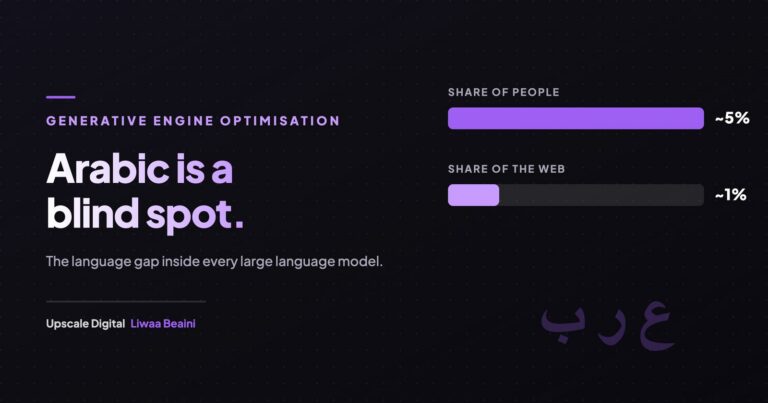
Yes, and it needs separate work. Arabic content is heavily underrepresented online relative to the number of Arabic speakers, which changes what the engines have to draw on. That deserves its own treatment.
Which engine should we prioritise in the GCC?
Start with ChatGPT and Google AI Overviews by reach, then add Perplexity and Gemini. Given the roughly 11% domain overlap between platforms, treat them as separate surfaces rather than one.
Where this leaves you
AI engines are already answering questions about your category in the Gulf, with or without your input. The brands being named are usually not the biggest ones. They are the ones with a clean, consistent, well-structured public record.
That record is buildable. Start by asking the engines what they currently say about you, and write the answers down. That single hour tells you whether you have a visibility problem worth funding.
Sources and further reading
- Ahrefs, analysis of 78.6M AI interactions across ChatGPT, Perplexity and Google AI Overviews, 2025.
- Surfer SEO, AI Overviews study covering 36M overviews and 46M citations, 2025.
- Goodie, cross-platform citation analysis, 5.7M citations across Gemini, ChatGPT, Claude and Perplexity, 2025.
- SearchAtlas, citation study covering 5.17M citations across OpenAI, Gemini and Perplexity, 2025.
- Statista, most-cited domains in large language model responses, 2025.
- Digital Bloom, AI citation depth and referral behaviour research, 2025.
- Conductor, AI search benchmarks on executive investment intent and strategy readiness, 2025.
- DataReportal, Digital 2025 reports for Saudi Arabia and the United Arab Emirates.
- 99Visibility GEO Academy, practitioner guides on citations, schema and E-E-A-T for AI search.
Want a free AI search audit for your brand?
We'll check your visibility across ChatGPT, Perplexity and Google AI Overviews for your top keywords — and show you exactly where to improve. 30 minutes, no obligation.
Book a Free Call